

What Climate Action Actually Looks Like for a Tourism Office
Let me lay out what the last three years have looked like for Aotearoa New Zealand, because I think we need to say it plainly: We are in the midst of a climate crisis and this is impacting our tourism sector. I'm not here to debate the science, that's settled. But I am here to highlight the increasing severity of our weather events and how we can respond.
January 2023: Cyclone Hale tracks across the North Island, battering Northland and the East Coast. Days later, Auckland experiences some of its worst flooding in living memory the Anniversary Weekend floods, which became the country’s costliest non-earthquake weather event at the time.
Two weeks later, Cyclone Gabrielle. A Category 3 storm that swept through Hawke’s Bay, Gisborne, and the Coromandel, causing loss of life and damage that exceeded every previous New Zealand weather event on record.
In April 2024, a slow moving moisture-heavy front stalled over New Zealand bringing 500-800mm of rain to the West Coast ranges, triggering swollen rivers, and slips that cuts access and wiped out roads spreading across the West Coast, Canterbury, and Otago. Wānaka, Queenstown, Dunedin, and Blenheim all receiving their top 5 wettest days in April in their history.
In 2025, a late-autumn storm in May puts Christchurch into a state of emergency, with winds exceeding 150 kilometres per hour in Wellington and widespread flooding across the South Island. In late June and July, Nelson-Tasman experiences its worst flooding since 1877; three successive fronts, states of emergency, seventeen homes rendered uninhabitable. In October, an intense storm isolates the entire West Coast by road, takes out three mountain passes simultaneously, and leaves 65,000 properties in Otago and Southland without power, some for over a week.
In January 2026, extreme rainfall likely triggered a landslide at Mount Maunganui bringing down soil and rubble onto the surrounding campsite and outdoor pools killing six people including tourists.
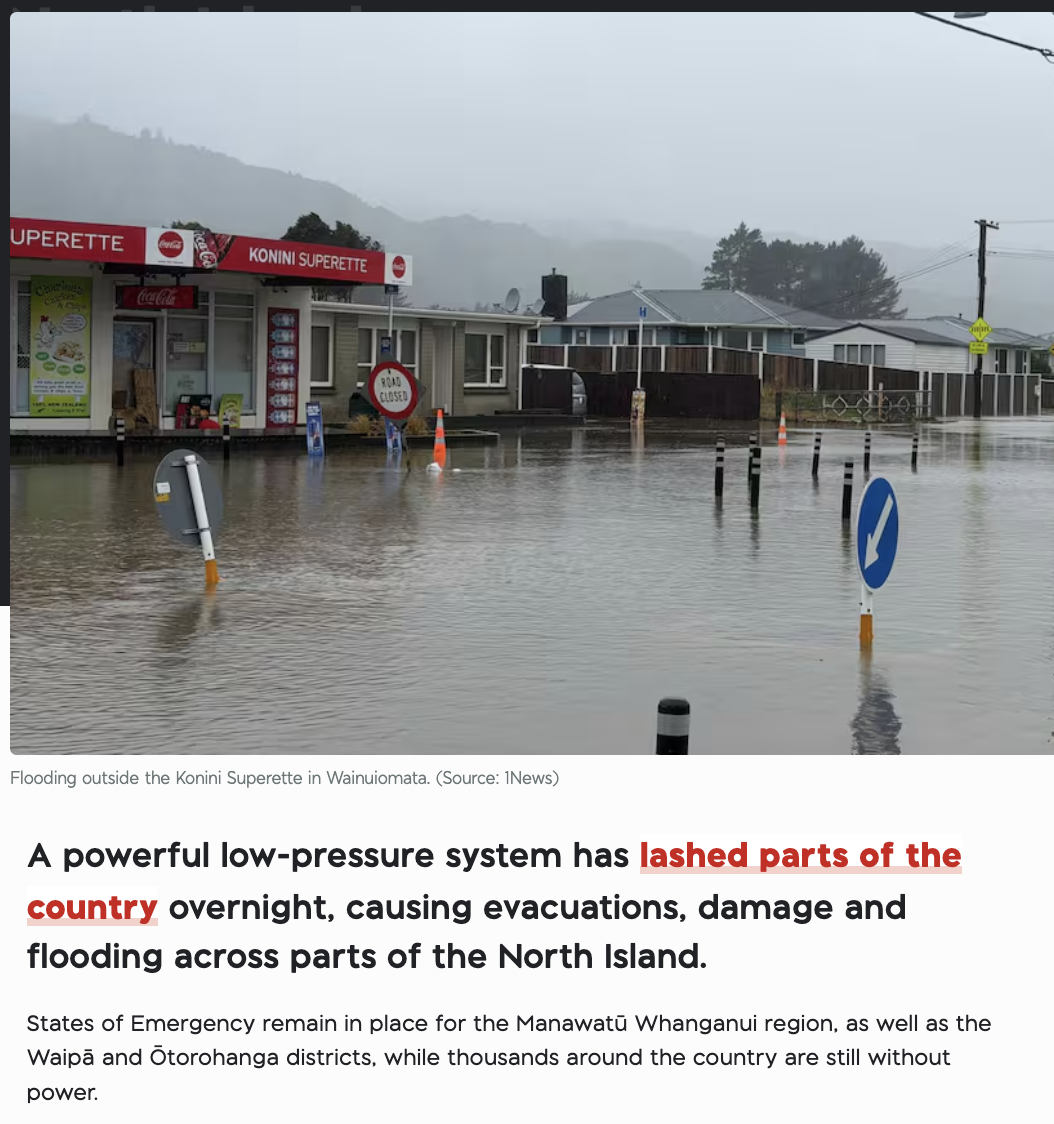
A low pressure system that arrived in February 2026 caused widespread flooding and damage across the North Island
In February 2026, a severe storm caused flash flooding in the King Country setting off a State of Emergency in the districts of Waipā and Ōtorohanga.
In April 2026, just two weeks ago Cyclone Vaianu arrived causing power cuts, flooding, evacuations, and road closures across the eastern North Island. 256 millimetres of rain recorded in the Ruahine Ranges. Wind gusts of 126 kilometres per hour at Māhia. Evacuations from Northland to the Bay of Plenty. A Paeroa resident , watching the water rise around her house, told RNZ: “I said to somebody, it’s like New Zealand’s getting a cyclone season. You wouldn’t have said that in the past.”
She is absolutely right. This is the pathway being laid out in front of us. Not as a future projection, as our present reality. It is not impacting our future tourism sector, it is already impacting us now and the visitors who are here too.
It is also the reason I have spent the past few months creating a series on climate adaptation for our tourism and event sectors because the gap between good intentions and grounded action in our sector is no longer enough.
The gap between intention and action
Most destination tourism offices in Aotearoa now have sustainability language somewhere in their destination management plans or visitor strategies, in their annual reports, and often in their funding applications. That’s progress, and I certainly am not here to dismiss that. But there’s a meaningful difference between having the language and doing the corresponding work. As these climate events become more frequent and more severe, that difference is becoming consequential.
Climate adaptation is not the same as climate mitigation.
Mitigation = reducing emissions gets most of the attention
Adaptation = actively preparing your destination, your sector, and your community for the changes already locked in gets far less.
Yet it is adaptation that will determine whether our destinations survive the coming decades.
The series I’ve been running covers five themes: understanding risk and vulnerability; destination resilience; events and contingency planning; sustainable practice as resilience; and the relationship between community, visitors, and the future. Each theme builds on the last. Together they make a case not just for why action matters, but for what action actually looks like.
Five themes, one through-line
Risk and vulnerability: You cannot prepare for what you have not identified. For most tourism businesses and destinations, a genuine climate risk assessment: mapping location, seasonality, supply chains, visitor patterns, and dependencies has not been done (or in the detail that is needed). That’s the starting point. It’s not pessimism; it’s the foundation of everything else.
Destination resilience: Resilience isn’t about never getting hit by a storm. It’s about how fast you recover. Recovery speed is shaped by four things working together: infrastructure, leadership, community cohesion, and visitor trust. Destinations that invest in these before a crisis recover measurably faster: economically and reputationally. Crucially, the natural environments that buffer climate impacts are often the same landscapes visitors come to experience. Degrading those systems costs twice.
Events and contingency planning: Severe weather is no longer an act of God in the eyes of funders, insurers, and councils, it is a foreseeable risk. Events that cannot demonstrate climate risk planning will increasingly struggle to secure future funding, permits, and insurance. The work here is practical: scenario-test your three most likely weather disruptions, get cancellation and postponement protocols agreed with suppliers before a crisis, and review your force majeure clauses with a climate lens.
Sustainable practice as resilience: Sustainability and resilience are not separate journeys. A business with lower energy dependency is less exposed when supply is disrupted. One with deep community roots recovers faster when disaster hits. Local supply chains are more resilient than long international ones. The framing matters: resilience feels like an asset, and when businesses see that it’s the same work, the motivation shifts.
Community, visitors, and the future: The visitor economy is often the first sector to feel the impact of a climate event and the last to recover. Community resilience and tourism resilience are inseparable. Globally, visitors are already shifting their travel choices based on climate perceptions away from destinations that feel exposed and unstable, toward those that feel genuinely prepared. The destinations building that credibility now are building a competitive position that will matter more every year.
Three things destination tourism offices should be doing and now
This is where I want land, with three clear asks for tourism offices specifically, because you have the scale, the mandate, and the relationships to move the whole visitor economy ecosystem.
Commission a climate risk assessment at destination scale: Not a survey. Not a workshop. A structured assessment that maps your destination’s exposure across infrastructure, natural assets, visitor flows, economic dependencies, and key seasons. Most individual operators won’t do be able to do this on their own - the scale and cost is prohibitive. But at a destination level, this assessment becomes the foundation for every investment decision, communication strategy, and policy conversation that follows. It also signals to your operators and your community that you are serious. Vague intentions do not survive a crisis. A climate risk assessment gives you something to act from.
Build relationships before you need them, especially with tangata whenua: The single biggest predictor of recovery speed after a climate event is not geography or funding, it’s relationships. The destinations that moved fastest after major climate events were the ones where industry, iwi, local government, and community were already in the same room on a regular basis. Trust takes time. You cannot build it during a crisis. Destination tourism offices are uniquely positioned to convene these relationships; to be the body that brings the right people together before the emergency, not after. That means showing up in climate adaptation planning processes at local and regional government level. It means meaningful, ongoing relationships with iwi and hapū as tangata whenua who hold extensive and historical knowledge about the land and its patterns. It means being known and trusted before you need to seek help for anything.
Replace vague sustainability language with honest climate communication: Visitors are increasingly climate-aware. They are already making travel decisions based on environmental values and destination credibility and they are increasingly good at distinguishing genuine commitment from surface-level greenwash. Destination tourism offices that communicate honestly about what climate change means for their destination, and what they are actively doing about it, build a trust that generic sustainability messaging never achieves. This does not mean leading with fear or projecting instability. It means having a clear, evidence-based narrative; here is what we face, here is what we are doing, and here is what visitors can expect. That narrative needs to exist before a climate event forces you to take action.
The shift that’s needed
There is a massive difference between being unlucky and being unprepared.
In 2026, if a climate event catches a destination off guard without a risk assessment, without tested relationships, without a communication framework, that is increasingly a preparation problem, not a luck problem.
Climate adaptation is not a destination you arrive at. It is a consistent practice you build over time. The relationships, the knowledge, the systems they compound. Every investment made before a crisis pays dividends during one.
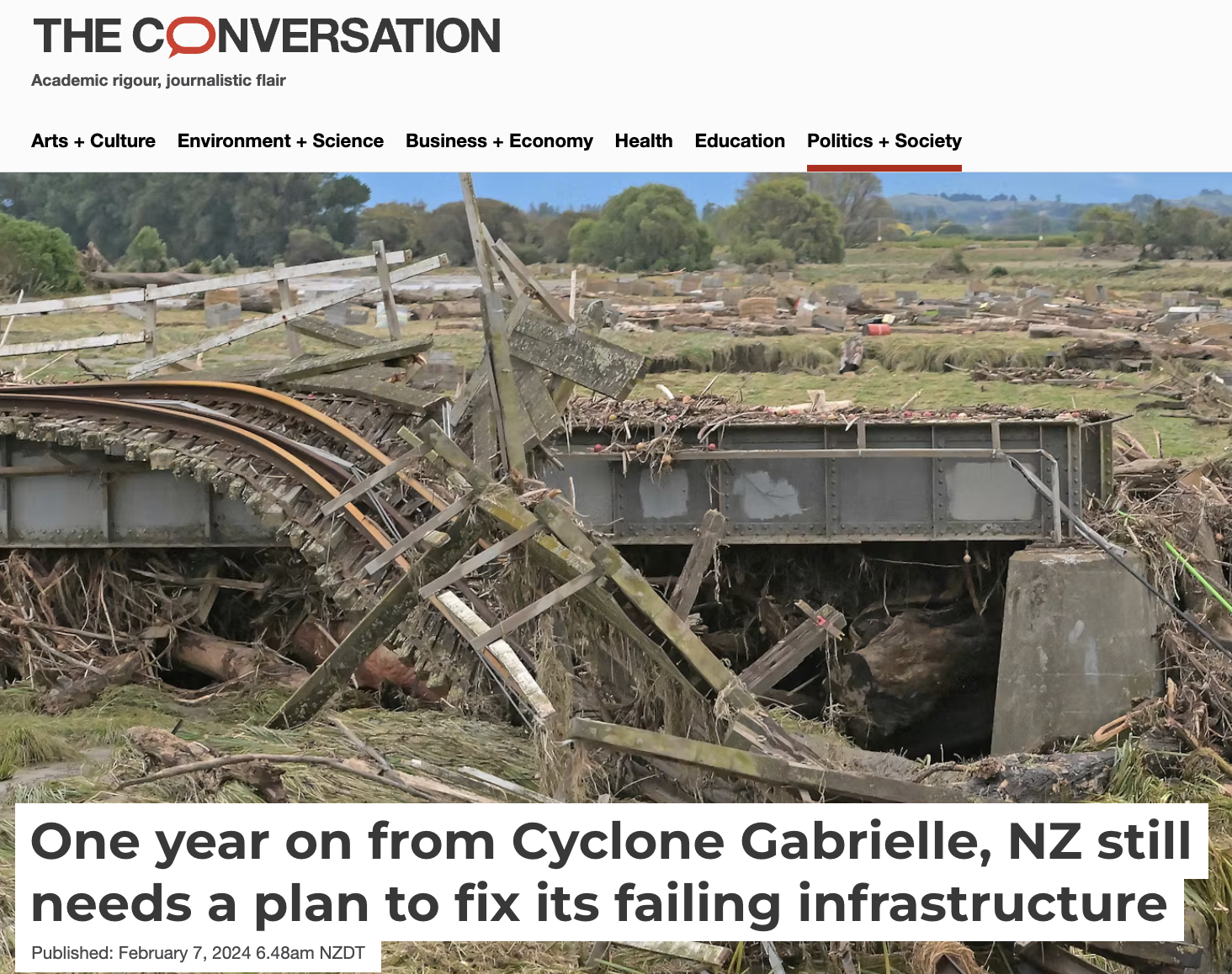
New Zealand’s infrastructure lag in the wake of major climatic events
I started this content series on climate adaptation because we had just come through another severe weather event, more lives had been lost, and I wanted to offer something useful through a short series of videos.
I have seen what inadequate preparation costs in Hawke’s Bay after Gabrielle and in the communities hit by every storm since. In dollars, in relationships, in the erosion of visitor confidence and loss of visitation, and in what it takes out of people who are doing their best to hold things together.
Our destinations, especially our regions are worth protecting. The landscapes, the communities, the experiences that make Aotearoa New Zealand an extraordinary place to visit. These are the same things most exposed to what is coming. Destination tourism offices have both the mandate and the lever. The question is whether we use them.